
Full of carnality and temptation, Blackbird‘s symbolic eighty minute long production is neither entertaining nor pleasurable; it’s disturbing in its imagery and in its content as it shines a spotlight on pedophilia. Inspired by a sex offender’s crimes, David Harrower wrote Blackbird which premiered at the Edinburgh International Festival. Cabaret’s Michelle Williams stars in this production along with Jeff Daniels. Blackbird directed by Joe Mantello is the story of a woman, Una, who confronts her childhood sexual abuser, Ray, a man considerably older than she. At the time of the abuse, Una was twelve years old and Ray was forty. Una tracks Ray down (he changed his name) after recognizing him in a photograph; she then visits him, unannounced, many years after his criminal conviction. She recounts to him the impact that the abuse had on her life as she tries to understand their relationship and he relays to her the consequences that he suffered as a result of the investigation and subsequent conviction. I wish that I could say that this play ends on a positive note, but I cannot. Furthermore, I wish that I could say that Ray ceases his pedophilia, but I cannot. Lastly, I wish that the abused held no sexual desire for her abuser, but once again I cannot. This play holds true to all of the evil that pedophiles exhibit and the impact of their behavior on the abused. It makes one gasp in horror at the end. (You must see it. No spoiler). Michelle Williams’s acting is stellar, and it helps drive the thematic content and the horrors of the abuse. The creative team’s use of props and its stage design symbolize both the carnality and sexual temptation that a blackbird represents, and the lack of freedom that Una has despite and because of the representation of blackbird. She, unfortunately, is not able to fly away.
Symbolism drives this play. Firstly, the action takes place in an office break-room with blinds drawn throughout the room. No one can see inside or outside of the room. The blinds represent secrecy. Secondly, there is an overflowing trash can. It represents the messiness of their lives. No custodian cleans up the mess. Perhaps people see the mess, but no one is willing to do anything about it. At one point Una suggests that Ray must be the office custodian. He says to her that he is not the custodian. Of course he is not the custodian because he is unable to clean up his own mess! During one scene of the play, trash is spread all over the office. It’s on the table, on the floor. The dirt is not contained to one spot. It impacts the entire room. The door to the office is kept closed, adding more to the symbolism of secrecy. She wants it open, he wants it closed so that no one will question why she is there. A fire extinguisher and a first aid kit hang on the wall. Ironically, no safety equipment could have saved Una from her molester. Primarily a two-person play, its casting also is indicative of secrecy. Often when molestation takes place, few people are around. Despite other people at the office, no one sees either character. Ray, however, constantly worries that someone will see Una and that he will be exposed (he has a new life and no one knows about his conviction). After everyone in the office has left, someone comes to see Ray. At that point the conflict of emotions become preeminent.
Michelle Williams’s portrayal of Una as a victim of abuse is extraordinary. The cadence of her voice epitomizes someone with nervous rapid speech trying to have her voice heard. She needs to tell her story before forces impede or try to stop her. Although she is a grown woman, she has a childlike nature as she struggles to understand her attraction to him (She is still emotionally drawn to Ray). Una’s emotional ties to Ray become apparent as Williams’s gesticulations and close contact with Ray increase with intensity as she pleads for a rekindling of their relationship. Jeff Daniels as Ray strongly tries to get Una to understand the impact of his conviction and his actions. Daniel’s performance is strong as he mimics the behavior of an abuser who vehemently denies his proclivity toward sexual abuse. His performance is superb, for the average theater-goer may feel disgust as if he were a real-life abuser.

The characters in Blackbird have no last names; they can represent any abuser or abused person. All of us have either heard of someone abused or we have known someone personally who has suffered at the hands of an abuser. Blackbird is worth the money and one’s time. Although it is not a fun night or afternoon out, it shines a bright light on a problem that never seems to go away. If you see something, say something. It is playing for seven more weeks at the Belasco Theatre.
 Alzheimer’s disease is both a difficult and depressing subject on which to write. It’s a topic that many people do not want to discuss, and if one is living with it as the caregiver or as the patient, it is an all-consuming subject that threatens to overwhelm one with sorrow. Yet, The Manhattan Theatre Club’s ninety minute production (no intermission) of The Father manages to tackle it with grace. Its production is both riveting and experiential. Doug Hughes directs Christopher Hampton’s translation from French to English of Florian Zeller’s emotionally written drama. Frank Langella plays André, the father, Kathryn Erbe plays Anne, his daughter, Brian Evers plays Pierre, Anne’s boyfriend, and Hannah Cabell plays Laura, the hired caregiver. This production through its brilliant writing brings the audience into the Alzheimer’s experience. How does it feel to be confused about one’s surroundings? About the time of day? How does it feel to believe that someone is a complete stranger, except that he is not? Thus, for experiential sake, and for a brief period, we are drawn into the Alzheimer’s patient’s world via a well written and translated script.

 Twenty-two years ago this month, one of the worst ethnic crises occurred during three months in Rwanda. This tragedy has been documented in many forms (Sixty Minutes, HotelRwanda, Sometimes in April, etc). Last summer, however, I read Immaculee Ilibagiza’s memoir of the Rwandan genocide, Left to Tell. In her memoir, she chronicles, with specificity, the impact that the Rwandan genocide had on her, her family, the Rwandan community, and even the world. She grew up in a devout Catholic family where she learned to have faith in Jesus through prayer. In 1994, her country experienced the genocide of approximately one million Tutsis in response to an ethnic war with the Hutus. Her family raised her to not value others based on artificial classifications, but on their actions. Unknowledgeable about her own cultural classification for many years, when she did come to learn about the…
 Electrifying! Captivating! Absorbing! Yes, the Royal Shakespeare Company’s (RSC) performance of the Henriad (Richard II, Henry IV Part One and Henry IV Part two, and Henry V) is superbly rendered while illuminating themes of: youthful indiscretion, revenge, guilt of conscience, honor, leadership, ill weaved ambition, betrayal, divine right, redemption, and reconciliation. The history of the House of Lancaster to the British throne is depicted in the RSC’s titled series, King and Country: Shakespeare’s Great Cycle of Kings, under the direction of Gregory Doran at the BAM Harvey Theatre in Brooklyn until April 30, 2016. By the end of the King and Country Cycle (April 30, 2016), the RSC will have performed it five hundred and five times in over twelve theaters on three continents. Celebrating the quarter centennial of Shakespeare’s death this month, the Folger Shakespeare Library via BAM Harvey Theater, contemporaneously with the RSC’s month long residency, is showcasing an exhibit extracted from historical documents relating to Shakespeare folklore in New York City during the nineteenth century and exhibiting original quartos of Shakespeare’s work.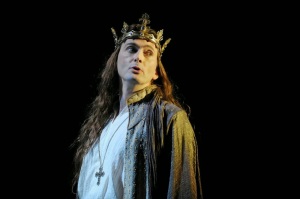

 All the World's a Set