
 It’s super fantastic! Young Vic’s production of Tennessee Williams’s A Streetcar Named Desire is worthy of every minute of this nearly three and a half hour long production, and of any accolades that it has received. Directed by Benedict Andrews with a superb creative team and awesome actors, this performance is emotive, it is heart wrenching. At the end of the performance, I started to shed tears. It is powerful. The family dynamics are evident to the extent that one can feel Stella’s pain at emotionally losing her sister and one can feel Mitch’s anger toward Stanley (This acting and directing intensity is what I longed to see in A Long Day’s Journey into Night). This production drew me into the story. I felt the anger, the rage, the intensity of emotion among the characters. Gillian Anderson, from the “X Files”, stars as Blanche Dubois, Ben Foster, from “Six Feet Under”, plays Stanley Kowalski, Corey Johnson stars as Mitch and Vanessa Kirby plays Stella Kowalski. Nearly two years ago, I saw the filmed version of this Young Vic production. I knew that a live performance would be levels greater, but I had no idea that the space at St. Ann’s Warehouse would greatly transform the play. This performance is theater in the round. The entire stage rotates slowly throughout the performance , with the audience seated around the stage, allowing the audience to see the play from different angles. At no time is the audience cheated as the stage rotates. The rotation, nevertheless, adds to the performance because it draws the audience into the play. St. Ann’s new space has the ability to convert to the demands of each play. The creative team amplifies this play to great heights. The crescendo of sound also transports the audience from scene to scene and the lights either illuminate or hide Blanche’s character. The costumes, the sound design, stellar acting, and brilliant lighting all work together to bring this magnificent story to a worthy stage.
A Streetcar Named Desire is set in New Orleans just after World War II. It is set in a modest neighborhood in the Latin Quarter of New Orleans. Streetcar tells the story of Blanche Dubois, the younger sister of Stella Kowalski. Blanche visits her sister’s home after losing her family home and her job. Blanche, however, fails to disclose the events leading up to her visit. Often inebriated, she fails to face reality. She still lives in the glory days of the past and makes her sister feel as if she is a failure. Blanche meets Stanley, Stella’s husband for the first time and dislikes him. He soon dislikes her as she attempts to place a wedge between him and Stella. Blanche meets Mitch, a man in whom she becomes interested. Stanley, suspicious of Blanche’s behavior, delves into her past. He learns that she prostituted herself at a hotel in her home town and that she lost her job as a teacher because of her lewd activities. Stanley tells Mitch about Blanche’s past. Mitch then severs their relationship. During all of this, Blanche unravels and drinks more and more to the point of becoming addled. Stanley in a fit of rage rapes her, while Stella is at the hospital after giving birth to their child. Blanche never emotionally recovers. At the end, Stella has made arrangements for the emotionally and physically battered Blanche to be hospitalized. At the end, Stella sobs as Blanche is taken away to a sanatorium.

The acting throughout the performance illuminates the characters and the play’s themes. Gillian Anderson plays Blanche wonderfully. When she first arrives on the set, we see her in all of her splendor, although it is a facade. Her clothing, her hair, and her voice all epitomize a southern belle. She maintains her southern accent although the performance. Her gestures, her stance, her walk all exemplify a woman from a high class status in life although she has fallen from her perch. As Anderson performs, the audience begins to feel sympathy for Blanche because we realize that Blanche is unraveling as the action rises. Anderson depicts a woman who falls further into an emotional breakdown. Moreover, Anderson and the others perform greatly because of Benedict Andrews’s awesome directing. Anderson stupendously portrays an emotionally wrecked Blanche, whose mind is greatly fragile and is unconscious of her own mental state. Ben Foster plays a pugnacious Stanley. He acts perfectly to show his contempt for Blanche. He intensifies his anger and his rage through his voice inflection, his countenance, as well as his movement. Foster is equally intense when showing his affection toward Stella. Both Kirby and Johson also play memorable supporting roles. At the close of the play, as Blanche is taken away, she and the doctor walk hand and hand slowly around the rotating set, giving the audience a full view of her emotional breakdown as Stella continues sobbing uncontrollably as the stage goes dark. The greatest irony is that she arrives at the beginning of the play at Elysian Fields, which, as she says, appears to be anything but that! She has arrived at dystopia, although real and not imagined, instead!
This production is one of the best. Rush to get your ticket today! This performance ends on June 4, 2016. You will not be disappointed. Try the standby line for tickets. It is worth it!
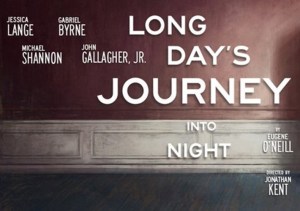 I am an eternal optimist. I tend to believe that with time, self-reflection, forgiveness, and prayer that most of life’s hurts can be resolved. But why does trauma destroy some lives while enriching others? Why do some people acknowledge traumatic events while others pretend that they are not happening? But what happens when life is too painful and we lack the wherewithal to accept what we cannot change? What happens is Eugene O’Neill’s Long Day’s Journey into Night (considered to be his magnum opus), a play that explores the Tyrone family’s ceaseless pain and the family’s emotional unraveling. Hurts that have not healed can cause family turmoil, the destruction of the family, and devastating family dynamics. What happens is drug addiction and the incessant drinking of alcohol to numb the pain. Published posthumously because O’Neill did not want it published during his lifetime, this play is considered to be semi-autobiographical. I am a lover of classic literature, for its themes endure for many years past its publishing date and speak to timeless ideas. I seized the opportunity to see the Roundabout Theatre’s production of Eugene O’Neill’s classic. The Roundabout Theatre Company’s cast includes: the incomparable Jessica Lange (Mary Tyrone), the seasoned Gabriel Byrne (James Tyrone), Michael Shannon ( Jamie Jr.), John Gallagher, Jr. (Edmund Tyrone) and Colby Minifie (Cathleen, the servant). This play under Jonathan Kent’s direction is three hours and forty-five minutes in length (the action takes place during one day and night) and I felt almost every second of every minute. This play is terrifically written, but it’s staging left me wanting more. Each family member’s detachment from each other and each character’s intermittent display of affection is depicted through the sudden fits of intense rage.
 All the World's a Set