Comedic Romanticism in Shakespeare’s The Two Gentlemen of Verona

Chicago’s Fiasco Theater presents Shakespeare’s The Two Gentlemen of Verona, purportedly Shakespeare’s first play. It is presented at the Polonsky Theater at Theater for a New Audience. After seeing many Shakespearean tragedies over the last year, I looked forward to watching one of his comedies. I’ve read about twenty of Shakespeare’s plays, but I had no recollection of ever having read this play; however, I had seen it many years ago before this most recent performance. After hearing the audience member’s comment, it caused me to reflect on the expectations of theater. Admittedly, I like to be stimulated intellectually, but I also like to laugh. Laughter without stimulation causes both fatigue and boredom. I enjoyed a recent performance of Hamlet and A Winter’s Tale considerably more than The Two Gentlemen of Verona. Considering the script, this contemporary performance adds both another dimension and depth to the play via props, costumes, set design, and lighting that helps the audience view the play in a contemporary manner instead of fostering nostalgia for the Elizabethan era. (Please see morethantheplay.blogspot.com with Domenick Danza and I for further commentary on this play).

Shakespeare’s The Two Gentlemen of Verona, a romantic comedy, is the story of love, friendship, and betrayal. Valentine is in love with the lovely Silvia; his best friend from Childhood, Proteus, is in love with Julia. Proteus, upon meeting Silvia at the Duke’s Court immediately surreptitiously professes his love for her, although he heretofore professed his love for Julia. Proteus is aware that he is betraying his best friend but he decides to woo Silvia in spite of behaving duplicitously. Silvia, however, has been betrothed to Thurio, a suitor for whom she has no interest. Julia, disguises herself as a man, so that she can reunite with proteus. She eavesdrop on Proteus’s conversations to find out information about Proteus and Silvia. Valentine is banished by Silvia’s father, the Duke, preventing his love for Silvia from prospering. During his banishment, he continues to pine for Silvia, as Proteus desires to plot and scheme to get Silvia. In the end, Proteus and Julia salvage their relationship and profess their love; Similarly, Valentine and Silvia, with the blessing of her father, join together in love, as he realizes that Thurio does not have the depth of character as Valentine.

The set is not elaborate but its simplicity adds to its simple elegance. The set is designed using white crepe paper that appears to have flowers etched into some of the paper. The minimalist set is composed of two white tall pillars that have tree branches at the top of each pillar. There are two benches with a rustic flavor on each side of the stage that serves as seats for the actors when they are not featured in the scene. The floor of the stage is that of a beach boardwalk. At the ceiling of the stage, there is a net that holds the crepe paper. The crepe paper has a whimsical romantic feel as if one is in a country backyard, as if an outdoor wedding is imminent.

Regarding props, the red paper on which a letter is written is fabulous when it is torn to pieces.  It is as if Valentine’s heart is bleeding from over sentimentality. When each piece hits the stage it punctuates both the love that he is feeling and the hurt by his inability to consummate his relationship by marrying Sylvia.

The costumes are contemporary. The men wear Oxford shirts with Khaki pants. One of the characters wears suspenders. All of the men wear saddle shoes. Valentine wears a purple Oxford shirt and Proteus wears mauve Oxford shirt. The women have short flowing white or cream colored dresses with an eyelet design signaling romance and purity. The clothes transport me back to the eighties when the preppy clothing was in vogue.
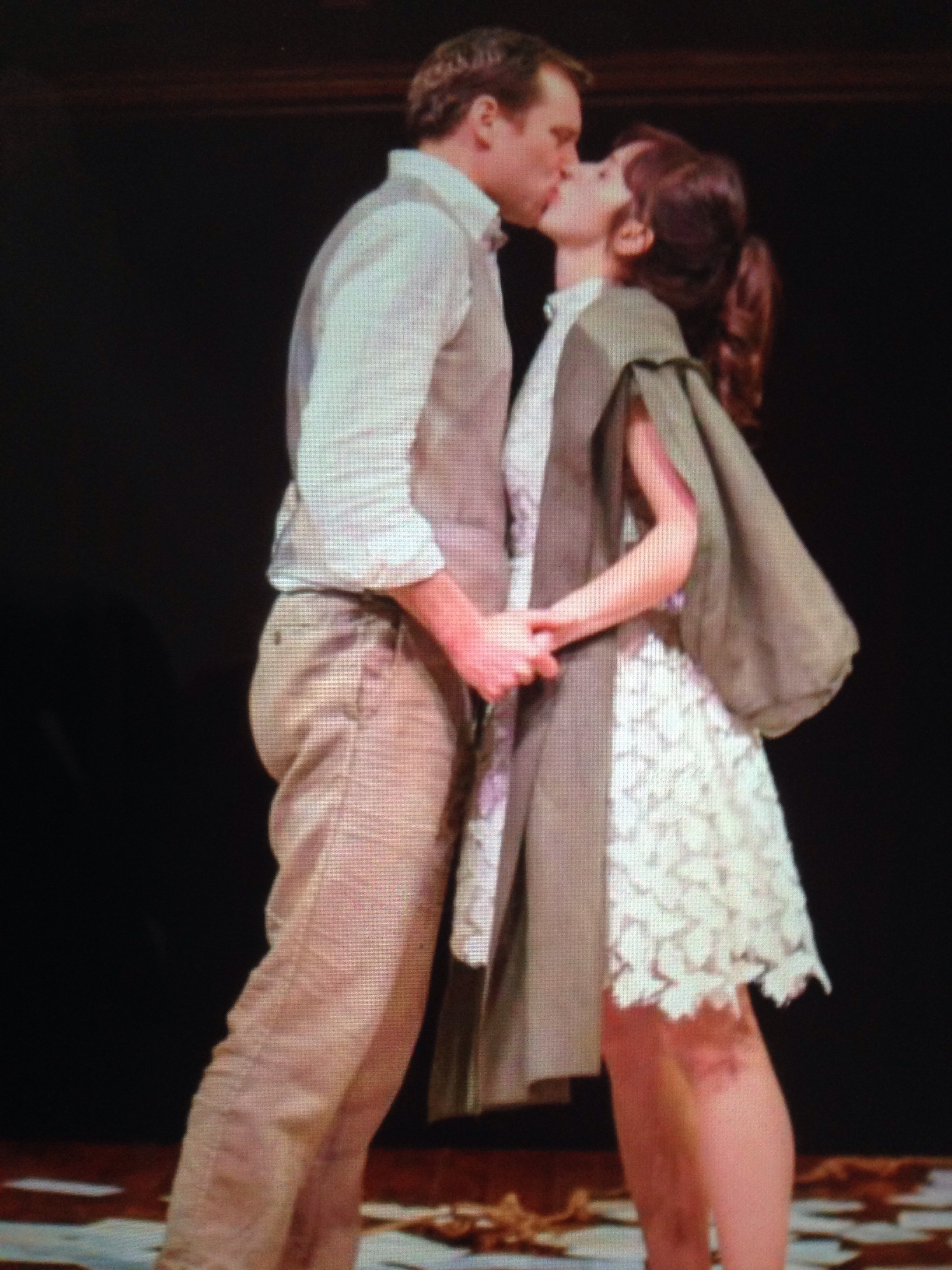
Zachary  Fine and Emily Young
Zachary Fine and Emily Young

Secondly, this fine youthful ensemble cast adds to the success of the play. When one thinks of marriage, youthfulness is usually apparent. Many of the characters play multiple roles which allows us to see the professional skill of the actors playing varied and distinguished characters. Before the play starts, the cast is on stage jovially playing with each other and engaging in conversations about the lighting and how they will look on stage.  it is obvious that they all work well together. Zachary Fine plays both Valentine and the dog. His emotions are somewhat melodramatic especially when he is banished and he is not able to see his beloved Silvia.  That scene seems to be cloying with extreme sentimentality. The love that he has for her is affective to the extent that the audience feel his emotions which move us to empathy.  He is equally effective and affective as the dog which adds more comedy to the play and makes us all laugh. Emily Young is adorable. Her pulchritude is evident and  we can see why Valentine loves her and why Proteus has fallen for her as well.  She is lovely with her beautiful white dress (which is evident of her purity) and exquisite beauty. The deep love that both Valentine and Silvia have for each other is evident and can be seen through the great chemistry that is depicted throughout the play. The characters exhibit great emotion when their reflection, passion, and despair are all needed to match the events in the play. The scenes with the dog are highly chimerical and they add high comedy to the play. Even characters are seen laughing at well acted scenes. Jessie Austrian plays Julia well. When dressed as a man to conceal her identity, she plays the scene well with great verve. Noah Brody as Proteus illustrate the character well for we see how Proteus is a cad because he allows us to see his own reflective thoughts aptly about his dishonorable actions.

From left : Emily Young and Jessie Austrian

Although, this play is not my favorite and the story lacks both the power and intrigue of Shakespeare’s tragedies, the modernization of this rendition helps one place himself into the lives of the characters who are similar to youthful romantic couples of today. The acting is great and the whimsical nature of the performance allows the audience to both chuckle and smile and subsequently say, “bravo.” Thus, in spite of a nearby audience member’s exclamation, ” I had forgotten how dumb this play actually was,” I actually enjoyed it for the comedy in which it was intended.

I am looking forward to The Public Theater’s Performance of The Tempest and Cymbeline (I’ve neither read nor seen Cymbeline) at the Delacorte Theater in Central Park. I hope that they will be just as ebullient with vivacity as The Two Gentlemen of Verona.

Deirdre M. DeLoatch
Deirdre M. DeLoatch

The High Line’s Whitney and its Physicality of Space

As I was leaving the Whitney on May 2 for the second time that day so that I could take a leisurely stroll down the High Line, I overheard a woman say, “Look at that line. Those people are dumb. They are going to wait in that line instead of waiting one more week for the lines to die down.” The lawyer in me wanted to politely respond, but I resisted because I was one of those people willing to wait in line (fortunately, I did not have to wait). I was able to make several reflections and observations that allowed me to see her thought process. I too have thought it dumb to wait in line for things for which I assigned no value. People wait in line for the things for which they are passionate. I understand now why people wait in line for the latest electronic gadget or for the latest sneaker to come out on the market. I have waited in line countless times for free tickets to plays and other forms of performing arts. Avid museum goers or artists are excited about the space and about the art. We like to be part of cutting edge movements and to see things that are aesthetically pleasing at their inception, not weeks later. Waiting another week deflates the excitement of seeing everything by hearing about it second-hand. It’s about experiencing something new as it’s happening. It’s about innovation.

E.E. Cummings Noise Number 13, 1925 Oil on canvas
E.E. Cummings
Noise Number 13, 1925
Oil on canvas

Today, at the Whitney my wait was short and it was tempered by having good conversation with the person (Joe) who was first in line. We talked about art for nearly one hour before we were let in for a community breakfast. He invited me in as his guest. As a result of arriving early, I had a personal tour guide for the entire exhibit, “America is Hard to see.” The title comes from a Robert Frost poem about the ideas which encompass America. Having been to some of the greatest museums in the world, the new Whitney is deliciously gorgeous. It’s not just about the art, but about the architecture and the use of the space to maximize the artwork’s design. The Whitney now stands alone. It is no longer clustered with the museums on the Museum Mile. It’s in a space unlike the other great NYC museums like the Metropolitan Museum, MOMA, and the Guggenheim. The cafe, the restaurant, the terraces, the views, all add dimension and depth that the other great museums in NYC lack. It’s the location strategically placed between the High Line and the Hudson River that puts this museum on par if not superior in location to the others. The architects, the executive officer, and the curators must be immensely proud of their accomplishments.

Reno Piano, an Italian architect, is the chief architect for the Whitney. He is known for his great museum designs. The design makes people smile as they view the art. The floor with rustic looking floor boards also adds beauty to the design as well as to the bright white walls. The use of the space allows the visitors to not just enjoy the art, but to also enjoy the beauty of the Hudson River and to enjoy the beauty of parts of New York City from above. Couch’s are strategically placed so that one can appreciate both the art of the American artists, the architecture of the museum, and the view of the City.  Near the couches, art work is either suspended or hung behind the couch. One piece of art, Negro Sunshine, is suspended from the ceiling as one gazes out the large windows. Outside at the back of the museum, there are abstract sculptures and table service for the top floor cafe. The museum guests can walk from one floor to the next via outdoor staircases or via the indoor stairs. This further enables the museum guests to fully appreciate the museum’s design.

Patrick Henry Bruce (1881-1936), Painting, c. 1921-22. Oil on canvas, 35 × 45 3/4 in. (88.9 × 116.2 cm). Whitney Museum of American Art, New York; gift of an anonymous donor 54.20

The inaugural exhibit at the new Whitney showcases the Museum’s American collection. Despite its expansive collection, most of the collection features only a few works by a few hundred artists. The collection lacks depth from most of the artists. However, one is able to gain a glimpse of the work of many artists. As a result, he can get his appetite whet so that he can explore in-depth these artists at another venue. The exhibit features artists who are American born and those who immigrated to the United States. Some of the prominent work features work by Jackson Pollock, Jasper Johns, Jacob Lawrence, Thomas Hart Benton, Ruth Asawa, and Kara Walker. As one views the exhibit, he should pause and reflect on the arts’ meaning. Many of us sometimes ask if a piece of art is truly art. We say, I could have painted that myself. I Am guilty of saying this myself without examining the thought behind the work. The honest truth is that we did not create the piece. Everybody is a critic. We all bring a sum of all of our experiences to every piece of art that we examine. We all see different ideas within one piece of work. That is what makes art unique. Art is subjective. Is it devalued because we think it’s junk? Who determines what is art? We should look at the history behind the art and look at the artist himself to gain a greater understanding of the artwork. I tried to insert some pictures of the terraces as well as pictures of other works so that one could gain a fuller sense of the beauty of the work and of the space, but I was not able to insert them into this post.

image
Richard Barthe African Dancer, 1933

Come to the Whitney Museum soon. It is unlikely to disappoint its visitors. Enjoy a leisurely lunch or an early dinner while taking in precious views of the city and of American art. Enjoy the High Line and see some of the best eye candy that NYC has to offer. This is likely to become my new haunt. Make it yours today.

Deirdre M. DeLoatch
Deirdre M. DeLoatch

For the Love of Shakespeare: Welcome to the Renaissance

https://i0.wp.com/www.nytix.com/repository/broadwayshows/2015/somethingrotten/something-rotten-large-643x441.jpg

Without planning and without hesitation, upon reading a preview of Something Rotten, a musical written by Karey and John O’Farrel, and both directed and choreographed by Casey Nicholaw, I rushed to the TKTS ticket booth to buy a ticket to the show.  This musical has a much accomplished creative team that will catapult this show to boffo box office sales. This show is pure entertainment. It is hilarious! It is stimulating! It is aesthetically gorgeous!  It had no tryout in London or in any other location. The Kirkpatrick brothers, having almost no theatrical experience believed that their show was going to be successful and opened on Broadway with stunning greatness. It’s that kind of confidence that is exuded in this performance.

“Welcome to the Renaissance,” the opening song of Something Rotten for both acts of the musical, sets the tone, at a high echelon, for the entire performance.  With this song comes great excitement, great energy and yes, great expectation (no pun intended). The minstrel and company arrive on the stage welcoming the audience to one of the greatest musicals in the last few years. It is an informal ode, filled with hilarity, to William Shakespeare, in spite of continuing controversy concerning his authorship of many of his greatest works. After they exit the stage, I was let down, albeit temporarily, because the opening act was difficult to rival and because it continued to echo in my head. After spending the last two months studying, teaching, and acting out scenes from Romeo and Juliet, and after watching a recent performance of Hamlet, it was natural to watch this spoof of Shakespeare’s greatest works, including the aforementioned plays as well as the recitation of his most famous sonnet.

This musical is about two brothers who are playwrights, but have difficulty getting employment as playwrights because of “The bard”, William Shakespeare.  As a result, Nick Bottom in desperation (Bottom was a character in A Midsummer’s Night Dream) consults an apothecary and seer, Nostradamus  (in real life Nostradamus was an apothecary with dubious prescience). As a result of pressure from Shylock, a money-lender (another Shakespeare reference) and Nostradamus’ prescience, Nick decides to do a musical, but his brother Nigel wants to be true to himself and wants to do something better.

This musical  has all of the elements of great theater: great musical score, superb costume and set design, unparalleled tap dancing and choreography, creative writing, compelling actors, a little romance (What is Shakespeare without two star crossed lovers?). Additionally, there are plenty of literary allusions. All the allusions make this a work of great erudition, but in a playful non didactic way. Although there are many lines taken from Shakespeare’s works and others have attempted works based on Shakespeare’s works, make no mistake, this is neither pastiche nor ersatz. In spite of this misappropriation from Shakespeare’s greatest works, it’s all done with both great antic and adroitness that all of the lines elicit chuckles and even appropriate guffaws. Some of the music is similar to musical selections from many Broadway musicals, but because of both the themes and content of the performance, the misappropriation is acceptable and adds to the hilarity. Others have attempted a similar work, but this musical out performs them all as result of a superb creative team that includes the director Casey Nicholaw from Aladdin and The Book of Mormon and Michael James Scott also from The Book of Mormon.

https://i0.wp.com/d3rm69wky8vagu.cloudfront.net/article-photos/large/1.172535.jpg
from left, Brian d’Arcy James, Christian Borle, and John Cariani

Something Rotten, opened on Broadway on April 22, 2015. Arguably,it  is the most well written musical to appear on Broadway since the arrival of the Book of Mormon, several years ago.  It may prove to be a juggernaut when the Tony nominations are announced on the 28th of April. The musical takes its title from Shakespeare’s Hamlet which has the famous line, “Something is rotten in the state of Denmark.” This music book is written by Karey Kirkpatrick and John O’Farrell and the music is written and composed by Kirkpatrick and his brother Karey Kirkpatrick, both musicians.  The musical stars Brian d’Arcy James and John Cariani as the Bottom brothers and Christian Borle as William Shakespeare.

Although this performance misappropriates lines and character names from some of Shakespeare’s greatest plays, as well as music, make no mistake, this is neither pastiche nor ersatz. Although there have been productions that have attempted a similar work, this performance has such well written songs (many with familiar tunes), well written dialogue, tap dancing, and superb actors with great verve that one never loses focus while watching this musical.  It is somewhat, however, highbrow with the creative writing, but one may never realize it. The audience member has to be well versed in Shakespeare’s famous sonnet, in Hamlet, in Romeo and Juliet, in The Merchant of Venice, and in Richard II. Having some knowledge of the controversy behind some of Shakespeare’s works also helps.  Moreover, having knowledge of the Renaissance would also add a greater dept to the understanding of the musical. If one is a musical buff and has seen musicals such as A Chorus Line, Dream Girls, Les Miserables, Cats, and has even the NYC Rockettes, then he or she is likely to have a greater appreciation of Something Rotten. If prior knowledge of musicals and Shakespeare is lacking, then the audience member will not understand the greatness of this musical. He or she will enjoy it, while never appreciating the brilliance of the writing. At the end of the show, I wanted to break out into Lionel Richie’s song, “All Night Long. and sing the lines “Let the music play on play on, everybody sing and everybody dance…” in tribute to the extraordinary music selections in the show.

Superb acting also helps make this show supreme among recent musicals. The Minstrel (a medieval singer of lyrical poetry) is played by Michael James Scott, from the The Book of Mormon and more recently as understudy for the genie in Broadway’s Aladdin. He sings and dances with great ebullience, that I almost felt like joining in with him. The song lasts for a number of minutes.  When it was over, I really wanted him and the ensemble to sing the song again.  Luckily, at the beginning of Act II, they reprise the song, although somewhat abbreviated. Scott sings and dances as part of the ensemble throughout the performance. His enthusiasm for the show is evident through his countenance. He seems to be the life of the musical. Shakespeare, played by Christian Borle’s,  walks on stage with great swagger and in garb reminiscent of Shakespeare. He looks just like the famous picture that many of us have seen of Shakespeare. He exudes confidence and ingenuity while acting this role. Every time Borle  arrives on stage and engages in duplicity and in artifice, his acting is near flawless. Brian d’ Arcy James and John Cariani deliver their lines well, but it is Borle and Scott who are supreme in this show.  Borle’s acting and Scott’s singing and dancing are what theater should be- engaging and compelling.

https://i0.wp.com/lang.presstelegram.com/projects/historic/images/styles/tudor-250px.jpg
Tudor home The set was designed to look like Tudor homes, reminiscent of Tudor era from 1485-1603.

The set design includes Tudor homes, (reminiscent of sixteenth century England) with thatched roofs and a theater with a proscenium arch.The original Globe Theater had a thatched roof which was the cause of the theater burning entirely. When the characters performed “omelette”, a parody of the real Hamlet, the new set design of a theater would come down from the top of the stage, mimicking a real theater. The set also includes a courtroom scene, that mimics courtrooms during the Elizabethan era .

Elizabethan costumes in the musical provide information about the status of the person wearing them.  The show is set in the 1590’s, toward the end of Queen Elizabeth I’s reign. The fabrics that the characters wear are dictated by society. The women’s costumes feature bumrolls, petticoats, and long sleeves. The costumes of the Christian characters in the musical wear are puritanical in nature to reflect their austere nature. The costumes add authenticity.https://i0.wp.com/images.renaissancecostumesclothing.com/products/3785/1-2/elizabethan-costume.jpg

For those of you who are Shakespeare aficionados or Shakespeare enthusiasts, this show is a must see. Do not delay.  Get your tickets today. The Tony award nominations are forthcoming.  I predict that Something Rotten will receive nominations for best musical, best book of a musical, best original score, best choreography, best director, best performance by a featured actor in a musical (Scott) and maybe best actor (Borle). Do not pass this by! A review of Hamlet, one of Shakespeare’s greatest masterpieces, is forthcoming.

Deirdre M. DeLoatch
Deirdre M. DeLoatch

Wolf Hall: From Novel to Stage

https://pbs.twimg.com/media/CCLrQoBWMAAcDYp.jpg:large
Similar to the seventies Heinz Ketchup commercial that said “Anticipation is making me wait,” the stage adaptation for Hilary Mantel’s Wolf Hall for months was making me wait.  For many months, I had eagerly awaited the stage productions at the Winter Garden Theater of Mantel’s novels, Wolf Hall and Bring up the Bodies, its sequel.  When I visited London a couple of months ago, I wanted to see the Royal Shakespeare Company, but because of travel time to Stratford, I decided to forgo the trip.  I was familiar with their work as a result of seeing them, in collaboration with another theater company, perform Shakespeare’s Anthony and Cleopatra last year. When I read about their pending repertory performance on Broadway, I knew that the quality of the performance would be extraordinary. I became so excited about the upcoming performance because I love classical historical drama and because all the shows that I have seen in London have been either captivating or riveting. I expected no less from the Royal Shakespeare Company’s production of Wolf Hall. Last week before seeing the stage adaptation of Wolf Hall, I decided to read the novel’s first two parts twice to gain a better understanding of all the characters in the story.  Without having a working knowledge of the history, keeping track of all of the characters was proving to be difficult. Upon reading it the second time, the characters became less obscure and much clearer. After reading parts one and two of the novel, Wolf Hall, I watched the first episode of Wolf Hall on PBS.  As a result, I became even more enamored with the text.  I was so enthralled that I googled many of the major players of this historic drama.  I wanted to ensure that I had an accurate understanding of the major historical people and events discussed.  Mantel, in many respects, keeps well in tune with the actual historical events of the life of Henry VIII; however, she refashions Thomas Cromwell to make him much more palatable than the version depicted in A Man For All Seasons (I read that in high school), allowing us to focus less on his malfeasance and more on his fidelity to the King and to Cardinal Wolsey.https://i0.wp.com/www.rsc.org.uk/images/content/wolf-hall-parts-i-and-ii.jpg

Hillary Mantel’s novel in two parts tells the story of how Henry VIII requested annulments from both Catherine of Aragon and Anne Boleyn because they were not able to give him a son as heir to the British throne. To help one understand the historical aspect of the story, Henry VIII married Katherine who was his brother’s widow.  He claimed that his brother never consummated his marriage and that his brother never touched Katherine, therefore he was free to marry her.  But after eighteen years of marriage, she failed to give him a son that would be heir to the throne.  As a result, he petitioned the Pope, via Cardinal Wolsey, for an annulment.  The pope refused over the protestations of Henry VIII. He married Anne Boleyn anyway and later had her executed for adultery, incest, and treason (she failed to produce a son).  Thomas Cromwell was his “right hand man” who helped the King accomplish his goals of annulment and subsequent marriages, all the while the King never achieved his primary of goal of having a male heir to the throne!  Little did he know that he was to blame!!

The novel was adapted for the stage by Mike Poulton.  Make no mistake, this play focuses on Thomas Cromwell and his relationship to Henry VIII and to Cardinal Wolsey. The other characters are essential, but the play gives great insight into Cromwell’s actions in relation to the Catholic Church and in relation to those around him. The play had its original runs in Stratford preceding its run on the West End in London before coming to Broadway. Ben Miles plays loyal Thomas Cromwell, a lawyer, Nathaniel Parker plays King Henry VIII, and Lydia Leonard plays the fearless and shrewd Anne Boleyn, who is later convicted  and subsequently beheaded for treason, incest, and adultery –  charges that are historically thought to be false. I saw each part of the play on separate days. The theater appeared to be sold out for the first part, but was only half full for the second part.  Even though the first part ended superbly with the foreshadowing of Jane Seymour, I surmise that either the length of the play or the subject matter deterred people from watching the second part.  The running time for each part is about two hours and forty-five minutes. Additionally, if one does not know the story of Henry VIII, he or she might have become confused by the twenty-four major characters and by about another twenty minor characters. As a result of reading the novel and watching the PBS Masterpiece series, I understood the content of the play. My suggestion for those who are seeking to see the play is to research some basic history of Henry VIII, Thomas Cromwell, Cardinal Wolsey, Anne Boleyn, Catherine of Aragon, and Jane Seymour. If one knows the key aspects of their lives as they relate to the British monarchy, understanding the play will not be as arduous. If one takes some time to research the history, then disappointment will be unlikely for the acting is superb and the writing keeps one engaged all the while already knowing how the drama is going to unfold and end. Even though I knew the ending, I remained riveted by the story and it maintained my engagement. Lydia Leonard was outstanding in her portrayal of Anne Boleyn. One should see the play for her dramatic portrayal.  Her performance will leave the average theatergoer wanting more from her, yet knowing that the story ends with Jane Seymour, the subsequent wife of the King after Boleyn. Don’t be dismayed, rumor has it that part three of this novel is coming! Maybe a drama will follow.

As a result of my prior knowledge of the novel and of British history, I recognized the action and many of the lines of dialogue in the play that were taken directly from the novel. For example, Cromwell discusses that in the Bible there is no mention of purgatory, no pope, no relics, etc.  He also discusses, William Tyndale, a leader in the Protestant Reformation. These references in the play are used as a basis for King Henry VIII forming the Church of England. Because of the enormity of Wolf Hall– nearly six hundred pages, the stage adaptation has only the most salient points of the novel and of British monarchy history.  Without starting from the beginning of the novel, which details Cromwell’s humble beginnings, the play periodically hints at Cromwell’s beginnings as the son of a blacksmith. The stage adaptation does detail, as the story progresses, the deaths of Cromwell’s wife and daughters from sweating sickness as well as the life of his only son. The sentiments of each of the major characters are accurately portrayed.  One can see that Anne Boleyn’s shrewdness is depicted accurately as well as the coy and subtle coquettish behavior of Jane Seymour, Henry VIII’s third wife. The great adaptation allows us to follow the trajectory of both Cromwell’s life as well as Henry’s VIII’s life and his wives.

https://i0.wp.com/static.guim.co.uk/sys-images/Guardian/Pix/pictures/2014/5/16/1400241645563/Ben-Miles-Thomas-Cromwell-003.jpg
Ben Miles and Lydia Leonard playing Thomas Cromwell and Anne Boleyn

Creatively this dramatic rendering does much with less. The set design features high cement towers that serves many purposes.  The lighting design and sound designed helps the audience to determine the actual location of each scene.  At times, the play is set on the Thames River. The sound of the water as the characters are on the boat gives a strong sense of location.  Other times, the characters are indoors and there is often a fireplace that gives us understanding of the location. The scenes at the Tower of London where Anne Boleyn and others were beheaded is dark and has a sinister atmosphere.The creative team does a splendid performance in its decisions of costume design. The costumes in the play are reminiscent of both the fifteenth and the sixteenth century. The costumes help one to be able to distinguish the characters from each other. Their power and their wealth were both displayed through their clothing. During sixteenth century England, velvet, wool and silk became sought after fabrics. The play’s costume fabrics are elegant and display the opulence of the monarchy. The hats that they wear also depict the era.

Although this play does not have many special effects, its strength lies in the writing and in the acting that are used to maintain your interest. Sometimes, plays use many techniques to either make a production greater or to mask otherwise weak productions; but, this production is great at its core without all the possible technology and elaborate set design. It’s set in the fifteenth and sixteenth centuries, a time when all of the advances were not on the horizon. There are no anachronisms that are out of tune with the setting of this historical drama. Perhaps in the future, we will see more dramas like this.

Please get your tickets to Wolf Hall– both parts!  This is a limited run of fifteen weeks. Even if you believe that the play will be difficult, watching this historical drama will not likely leave you disappointed.  You will be both engrossed and educated at the same time. Why not give it a try! As I finish this post, the PBS drama awaits me! Yes, I still want to watch the drama unfold, even though I know the entire story.  The reviews for that series have been on par with Downton Abbey. What can I say? I love both great writing and great theater.

Starting in July, Lin Manuel Miranda’s Hamilton, a historical musical, will be appearing on Broadway after a successful run at the Public Theater in New York City.  I was dilatory in getting a ticket and I have had no success at the Public’s ticket lottery.  I hope to get a ticket for this upcoming Broadway production. I’m expecting it to be as great as Wolf Hall. Reputation is everything! Comments welcome.

Deirdre M. DeLoatch
Deirdre M. DeLoatch

Josephine Baker: A One Woman Show

https://i0.wp.com/www.publictheater.org/PageFiles/9382/JI_370x238.jpg

On a recent Friday night at Joe’s Pub (restaurant and performing arts venue at the Public Theater), while waiting for Josephine and I to begin, I have slight trepidation about the performance I am expecting to see. I am wondering if the artist playing Josephine Baker is either going to appear on stage with a skirt made of bananas or whether any of the costumes worn will be risqué.(The banana skirt was one of Baker’s most controversial costumes). I hold my breath and say, “I hope not.” I, along with many others wait for the show to start. We see what appears to be a stage worker, whisper to the pianist who is playing a nice cabaret style composition. The pianist then plays the composition again and again and again. Apparently the pianist is told that the performer is going to be late. My table mates and I whisper, “where is she?” Then, the performer, Cush Jumbo, rushes onto the stage with coat on and bags in hand, offering up apologies for her dilatoriness. She says she just came from an audition that was for a great show about which she cannot tell us. She takes her coat off says a few words of explanation about artists’ lives and then flawlessly becomes Josephine Baker. At that moment, I ask myself, if the previous routine is part of the show. Yes it is! Her acting is sheer perfection. Thus, begins the show, Josephine and I! For the record, Jumbo never puts on the banana skirt! It is only discretely mentioned during the performance. There is nothing off kilter about this performance. For those who are not familiar with Josephine Baker, the show offers up a cultural history that is worth watching. Within five minutes of the show, I realize that I am about to see a splendiferous performance with both great originality and flavor.

https://i0.wp.com/ia.media-imdb.com/images/M/MV5BMjA2NDYwNjQwNF5BMl5BanBnXkFtZTgwODAzNTY2MDE%40._V1_SX214_CR0%2C0%2C214%2C317_AL_.jpg

During the month of March until April 5th, Cush Jumbo (also the playwright) performs this show at The Public Theater in NYC. She is supported by an award winning creative team. The show is directed by Phyllida Lloyd and Anthony Ward is the scenic and costume designer; Joseph Atkins is the music director. This solo show was first performed at The Bush Theater during the 2013 season. Recently, Jumbo appeared on Broadway, alongside Hugh Jackman, in The River.

When Jumbo was younger she came across Baker and marveled at her success and how Baker resembled her in color. Jumbo, a fair woman of color, decided to research the life of Baker. She became intrigued with her life and how she navigated the waters of racial hostility in America.

Jumbo’s one woman show is a success.  She captivates and at times rivets the audience during the scenes that explore the complexity of some of the unpopular decisions that Baker made as well as how the NAACP supported her and how and she handled the racism of the time during her career in the United States. Jumbo shows the transition that Baker made when she adopted France as her new homeland, a practice common to black artists of that era. She makes some parallels between her life and that of Baker’s.

To add historical accuracy, Jumbo uses mixed media to convey the sentiment of the time regarding Baker’s career while Jumbo depicts her own professional career. Through these real life recordings, we are catapulted to the time period with great historical accuracy and specificity. Additionally, through video projected newspaper clippings, and exquisite acting, we experience verisimilitude, a technique that makes the performance engaging. We experience Baker as a blacklisted artist. The mixed media allows the audience to feel the hostility that Baker faced as an artist in America.

Through music, dance, and storytelling Jumbo superbly offers up a great rendition of Baker’s life while gently weaving in details of the challenges that she and Baker both faced as artists. She explores how artists engage in actions that others do not understand. They take roles that are not considered kosher so that they can further their careers.  Moreover, she infuses these ideas not to change your mind about Baker’s actions, but to give insight into the decision making that actors face especially when confronting bias. When Jumbo transitions from Baker’s life to that of her own, at first, it seems like an unwanted interruption, but the acting is perfect and the audience is allowed to see the connection between both artists’ lives. One of the transitions appeared to be longer than I would have liked, but she superbly acted the scene; thus, it is easy to forgive the intrusion of the lengthiness of her own story. She tells these stories with both great dance and music to the extent that the transitions overall are well done and do not detract from Baker’s story. Jumbo apparently studied Baker’s dance choreography and is able to replicate some of the dance movements.

https://www.bushtheatre.co.uk/wp-content/uploads/2013/07/20130715-125237.820_105-2000x1428.jpg
Performed previously at The Bush Theater

Anthony Ward, the costume designer, is a Tony Award winning theatrical set designer. The costume design, filled with both glitz and glamour, was fabulous. The costume changes were seamless. Often through the show, Jumbo puts on and takes off various costumes to reflect the different performances in which Baker engaged. She often took off parts of a dress or skirt while putting on other parts to make the outfit slightly different.

Jumbo makes maximum use of her audience to maintain engagement. Throughout the entire performance, Jumbo makes us feel part of the show. During one of the scenes she talks to an audience member, but it is actually part of the script. Additionally, to maximize audience engagement, tables are used to maximum effect. We were asked to light candles during one of the scenes. Moreover, in the theatrical space, there are dolls representing the many children of various races, religions, and ethnicities that Baker adopted. These dolls are placed strategically throughout the room. Jumbo then continues her performance as she walks about the room performing her routine as she infuses the issue of race, via the dolls, as neither an essential nor preponderant quality necessary for both love and acceptance.https://rebeccamcwattie.files.wordpress.com/2012/05/josephine-baker-funral-2.jpg

Near the end of the performance, Jumbo effortlessly reenacts Baker’s last performance in Paris at the Bobino. It was a sold out crowd. Baker, in Paris, had not performed for a period of time due to illness. It was a celebration of her fifty year career as an entertainer. Baker, via Jumbo, gets back on stage and gives what became her final performance to great reviews.  Jumbo ends the show showing how Baker spent her final lucid moments before suffering a cerebral hemorrhage which ultimately resulted in her premature death. She was reading the reviews of her show in the newspapers – a regular custom which she practiced.

https://i0.wp.com/www.doctormacro.com/Images/Baker%2C%20Josephine/Baker%2C%20Josephine_01C.jpg
Josephine Baker in all her glory and splendor

Jumbo maintains historical accuracy that is not overly didactic, but entertaining. I left feeling excited and thoroughly entertained. using ideas from the film, Seymour: An Introduction, it is both the dissonance and the harmony of life that allow us to play life beautifully. Jumbo’s spirit embodied it. I say to her and others like her, play on! Through music, dance, and storytelling we get a beautiful glimpse into the artistry of Josephine Baker. The fortieth anniversary of Baker’s death is April 12th. Why not celebrate it by attending the show or by reading about Baker’s life? The tickets are reasonably priced and $20 rush tickets are available the day of the performance. It’s at Joe’s Pub at The Public Theater. Have a good dinner or lunch with entertainment! Performances continue until April 5th. If you cannot see it then, it will appear at Steppenwolf Theater in Chicago after its run at The Public Theater. Comments welcome!

Deirdre M. DeLoatch
Deirdre M. DeLoatch, blogger

London: Truly an Artistic and Theatrical Experience

image
This is the London Eye. It can be seen all over London! Wherever I walked, I could look toward the sky and see it. It is awesomely beautiful at night!

Several years ago while visiting the United Kingdom, a cab driver quoted, in a satirical manner, a familiar UK saying that states “The sun never sets on the British empire.” I assumed that meant that the British thought very highly of themselves and that it was a statement of grandeur because the light would never dim on any of its territories. It meant that and more because of its expansive empire that spans the globe. The sun was always shining on one of its territories at all times throughout the day. Although the British territories are not as expansive as they once were, Britain still has both elegance and allure that has caused a certain amount of je ne sais quoi that caused me to think about visiting London. I previously went to Scotland and enjoyed Glasgow and Edinburgh. I imagined that this trip was going to be vastly different from Scotland.

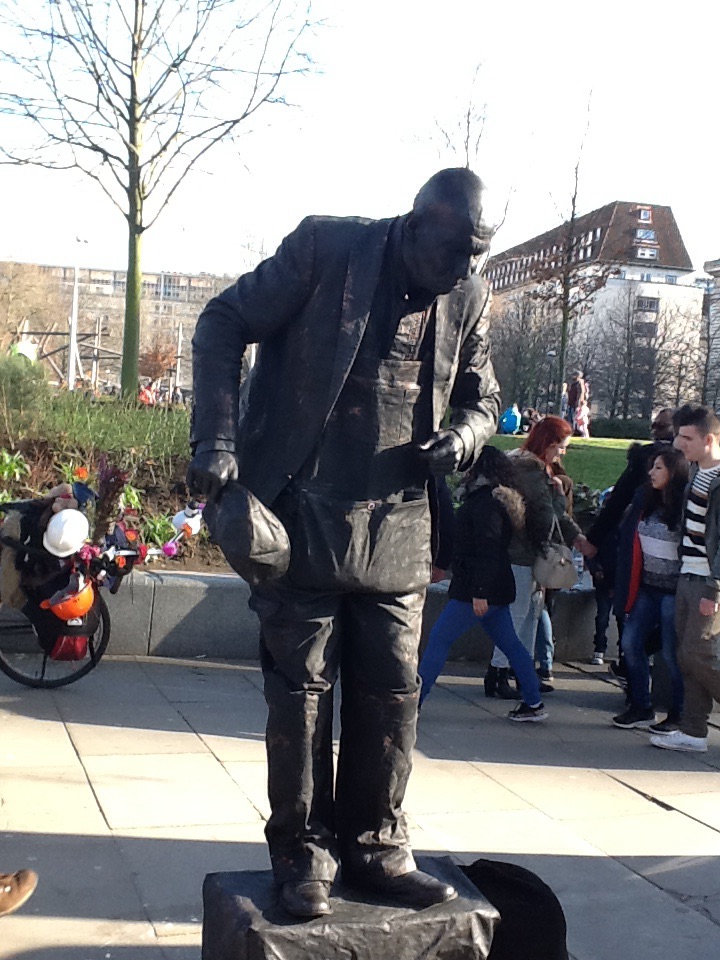
Who started this spectacle? New Yorkers or the British?
This is an actual person who stays like this all day! Who started this spectacle which has now become a pastiche? New Yorkers or the British?

In February 2015, I made my journey to  London, a global city with which I had become enamoured. I had previously never desired to visit London because I always enjoyed going to more exotic places- countries with a culture vastly different from my own; however, since I started having a more voracious appetite for the theater, I decided that I would go to the West End to comparatively analyze theater and visit central London to get both a taste and a feel of the local culture and local color ( I previously viewed productions in the US by London’s National Theater and by London’s Young Vic ).  Moreover, I had become increasingly enthralled with several BBC shows like Downton Abbey, Mr. Selfridge, and Call the Midwife (and others).  As the last few years past, I realized that I had become an anglophile. While watching Shakespearean plays annually and becoming ensconced with British phrases and accents, I realized that I both admired and respected both British theater and television. Logically I decided that the best place to visit on my vacation would be London.  My goal was to see as much theater that I could afford to see and to go to as many art exhibits that was humanly possible. Because I am an avid walker, I decided to walk everywhere in lieu of the tube or the bus.  I walked about twelve hours daily so that I could enjoy all of the local flavor. I visited the National Theater multiple times as well as a couple of theaters in the West End and five museums, each with its own focus. As a result, I gained a greater appreciation and cultural awareness for both the British culture and for my own. As anywhere, one can reside at hotels of great grandeur or hotels of more modesty. I stayed in Fitzrovia at St. Giles, a three star hotel with a full breakfast, in the heart of the West End.  European hotel accommodations tend to be small. I expected a small room because I booked a single room. The concierge and other workers were exceptionally genial toward me. Although the room was small, it did not matter. I only intended to sleep there, thus the only thing that mattered was its cleanliness. If one is looking forward to attending the theater in the West End, I highly recommend St. Giles. The Marriott Hotel, although pricier,  is located on the South Bank in proximity to the National Theater and It has all the glitz and glamor that goes with a four star hotel. The Ritz Carlton, is located in Picadilly, a half hour walk to the theater district. One can get a superb afternoon tea there, but the cost is much greater than at other locations.

I've never seen such opulence in a department store as well as mouth watering desserts. I did manage to buy some perfume, Spring Flower, by Creed.
Harrods, the most opulent department store in which I had ever shopped. I managed to buy a pistachio pastry and some purfume, Spring Flower, by Creed.

From the moment I arrived at the hotel,  I was captivated by the frenetic pace of the city, by the avuncular people who often helped me when I looked lost, and by the people moving about while enjoying good sunny weather- three words that do not normally go together in London.  I absolutely adored London. I cannot say it enough. I am not sure whether I adored it because the culture was acutely aligned with my own American culture or because of the quality of the theater and other performing arts. I spent time walking all over central London. As a peripatetic person, walking pleasantly suited me and I did not tire easily.  I loved the architecture and the general beauty of the city. I visited both Selfridges and Harrods. I could have spent days basking in the opulence of each store while enjoying afternoon teas and tempting pastries that truly were works of art. The price tag attached was commensurate with their worth. Selfridges now boasts that it is the only department store with a cinema. The main film that seemed to be ubiquitous throughout central London was Fifty Shades of Grey. I decided, however, to pass on that film. The main thought that I came away with regarding British culture as I walked and perused stores was the extent that British culture influences American culture. It became apparent that the American culture is a pastiche of British culture.  The nomenclature of both countries is the same (street names, districts, etc). The one thing that we have not esteemed to the same level as the British is enjoying a cup of tea. We are more fascinated with coffee than with tea. The British are still arguing over how to best enjoy a cup of tea. Does one put the milk in first or last? How hot should the water be? Tea bag versus loose tea? How long is it steeped? After enjoying English Breakfast during the morning and in the afternoon daily, I thought I might have caffeine withdrawal upon disembarkation at Kennedy. Would you like a pot of English Breakfast?

The National Theater Have you seen any of their filmed productions? They are spectacular, especially if you cannot get to London or cannot see their productions on Broadway or elsewhere.
The National Theater
Have you seen any of their filmed productions? They are spectacular, especially if you cannot get to London or cannot see their productions on Broadway or elsewhere.

Before going on holiday (British vernacular of course), I researched the plays that I was interested in seeing.  I narrowed the list down to six and I made my final decision upon arrival the first day.  Visiting London without attending theater is like touring New York City without ever seeing Broadway, Times Square or the 9/11 Memorial. Why would anyone travel so far without ever taking in the Theater?  While in London, I visited the New Globe Theater and the National Theater. I took tours of both theaters including a back stage tour of the National Theater. The new Globe was financed by Sam Wanamaker. It is open during the spring and the summer. Bring blankets to keep warm, as it is an outdoor theater.  Contrary to the outdoor New Globe Theater is the indoor National Theater that has three theaters with many plays running concurrently. The National theater boasts about having a  drum revolve that is five stories high and contains several elevators used to hoist huge objects onto the stage. It is one of two in the world. I loved the National Theater with its cafes, its restaurants, its bookstore and its general ambiance.  One could stay there all day and read and relax or enjoy a great dinner before a show. Even though I attended the theater alone, I met people during the interval (vernacular for intermission).  I engaged in conversations about the British and about New Yorkers.  If ever one is undecided about attending the theater alone, it can be a great experience.

image
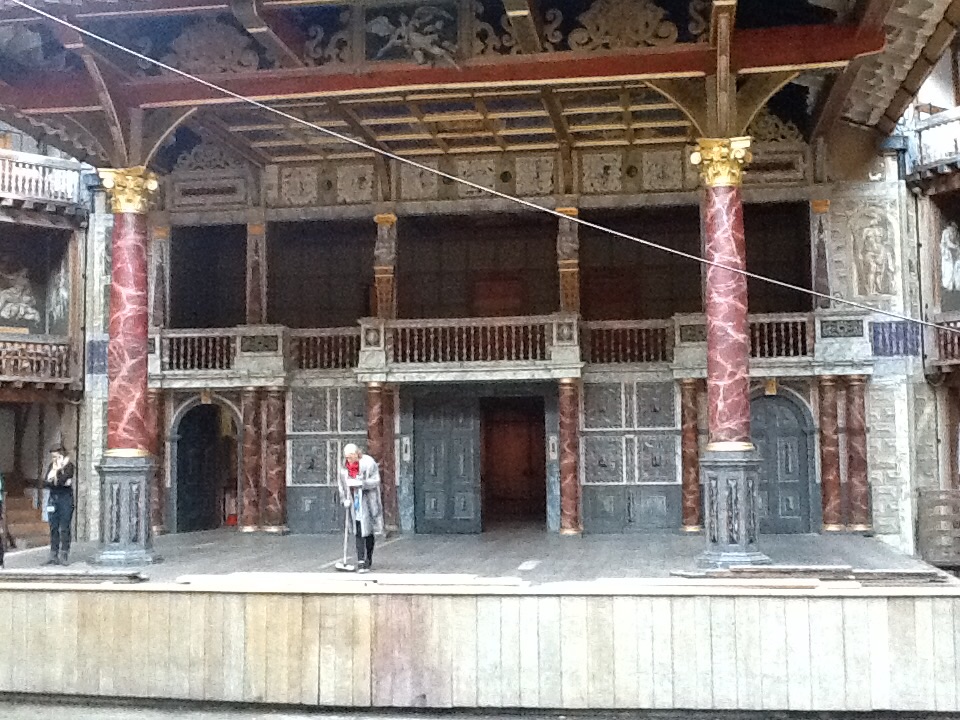
The New Globe Theater is built to be a replica of the original Globe Theater. I took a tour and learned interesting facts about the productions at the original Globe Theater.

While in London, I saw five plays. I saw Man and Superman, by George Bernard Shaw. This play expands on Nietzsche’s concept of superman in which man explores his own morality and shakes off the conventions that have been placed on him. The main character is played by Ralph Fiennes who tries to live by his own set of rules  and opines on women and marriage. This four hour performance was exceptional.  I also saw, A View from the Bridge, in the West End. It was directed by Ivo Van Hove and written by Arthur Miller. It was fresh on the heels of their Young Vic production. It is my belief that this play will arrive on Broadway within the next year.  We love Arthur Miller and we love Brooklyn. The play was spectacular (I will review it in a separate post). If it arrives here, I strongly recommend it.  Additionally, at the National Theater is Behind the Beautiful Forevers, a play adapted from the non fiction narrative by Katherine Boo. This play is about a group of people who live behind the airport in Mumbai. This group lives in the shadow of great development in Mumbai while millions continue to live in indigence. This play is emotionally moving, and it prompted me to read the original narrative.  Also, at the National Theater is Tom Stoppard’s new play, The Hard Problem.  The play explores consciousness. It asks the hard questions about the things of which we are aware and that can be proved.  Although Stoppard is known to be logorrheic, the issues discussed were fascinating and the verbosity of the play did not detract from its themes. The set was minimalistic and the acting was superb. The lead actor, Olivia Vinall, reminded me of Carey Mulligan in Skylight. She was passionate in her beliefs as she opined on her belief of the consciousness of God. Do coincidences exist or are we merely unaware of the circumstances that create them? Does God exist or are we orchestrating our own paths? Lastly, I saw War Horse, which was great in spite of technical difficulties that caused the show to stop for about ten minutes to correct the problem.

The National History Museum had the most awesome exhibits. The best was the "cocoon." The cocoon was giant and inside the cocoon was a huge exhibit spanning many floors.
The Natural History Museum had the most awesome exhibits. The best was the “cocoon.” The cocoon was giant and inside the cocoon was a huge exhibit spanning many floors. Its bustling with people.

Viewing exhibits at various museums proved to be an enjoyable experience filled with didacticism, yet not dull in its presentation. I visited the Tate Modern, The Natural History Museum, the British Museum ( I saw the Rosetta Stone), and the National Portrait Gallery and the Museum of London, which is the most comprehensive museum about the history of London. It chronicles the great fire of London as well as the Roman occupation of London.  It is filled with details about Londoners dating back more than a thousand years. Currently on exhibit there is Sherlock Holmes: The Man Who Never Lived and Will Never Die. It is there until April 12, 2015. After having watched the Hound of the Baskervilles and some other Sherlock Holmes films, I became intrigued with the story.  Often I have believed that he was a real person because very few people mention the author of the works, Arthur Conan Doyle.  The exhibit begins behind a book case that presents itself as a library.  One must tap the “books” to enter the exhibit and then the exhibit opens. This is something that one would experience when watching his films. Inside the exhibit are artifacts, films, portraits, paintings and anything that is related to Sherlock Holmes via Doyle.  The layout of the exhibit was spectacular.  One could watch clips from some of the films and well as read about Conan Doyle’s life.  If one were not familiar with his work, the exhibit would cause one to have a keener ( I cannot tell you the amount of times I heard “keen” used in London) interest in Sherlock Holmes. The exhibit encompasses the many actors who have played Sherlock Holmes, including the most recent actor, Benedict Cumberbatch. Sherlock Holmes is quintessential London.

The National Portrait Gallery gives visitors a great history of the kings and queens of England. Viewing the exhibit has inspired me to gain a more complete picture of the history of the British monarchy. Much has been written about the British monarchy, but the exhibit gives a complete and accurate history without embellishment.  Currently on Broadway are two productions about the British monarchy, Wolf Hall (Parts I and II produced by the Royal Shakespeare Company starts March 20th) and The Audience.  All anglophiles are rushing to get tickets now!

imageAs a result of my vacation, I have gained more wisdom from traveling and I have a better consciousness of London and its environs.  I am now positioned to return and branch out to other areas of England and also to visit Wales and Northern Ireland. When I return in subsequent years, I will continue to visit the theater and art museums. I will also visit Stratford so that I can see the Royal Shakespeare Company and the place of Shakespeare’s birth. I learned that if I am having difficulty understanding someone, it is also likely that he or she is having difficulty understanding me.  Walking and not taking bus tours is really the best way to get around (if you can walk without fatigue).  When converting currency, always use “the hole in the wall” (vernacular for ATMs). The best rate is given through the machine. Bring a small amount of local currency before arriving. Always include respite in your day by having an afternoon tea at one of the better locations. Get to know some of the locals. That is how one learns the true culture of a place. Take time to enjoy the night life.  London is a beautiful city at night. I cannot wait to return. In the meantime,  Wolf Hall awaits me as well as the new season of Mr. Selfridge. Has anyone seen Eastenders? Cheerio!

Shakespeare in the 18th Century: A Magnificent Blend

The Royal Shakespeare Company and Miami’s GableStage via New York City’s Public Theater, have done the impossible in juxtaposing two important pages of history. In their desire to bring the original Shakespearean tragedy, Antony and Cleopatra to a new era, these two companies went to the 18th  century at a time in which prejudice and racial discrimination ravaged the Caribbean.  The play, wonderfully directed by Tarell Alvin McCraney, stars Jonathan Cake as Mark Antony, Charise Castro Smith as Octavia, Samuel Collings as Octavius Ceasar and  Joaquina Kalukango as Cleopatra, and a cast of other talented actors.  To entertain and to introduce the audience to the music that is infused in the play, there are exemplary musicians who play folklore, traditional Haitian music, before the play begins.  The well-known story of Antony and Cleopatra brings tears to many theater goers’ eyes, and has taken passionate love to another dimension when the companies  in a parallel attempt move back and forth  from the Roman Empire to the Haitian Revolution against France in the late 18th century.
As the story unfolds people familiar with global history relive the poignant and passionate love story of the Egyptian Queen Cleopatra who is madly in love with Marcus Antonius (known as Mark Antony).   After the breakage of the triumvirate, war was inevitable between Gaius Julius Caesar Octavianus (Octavius) and Anthony. The ill-fated love so characteristic of Shakespearean theater culminates with the suicidal and tragic death of the two lovers.  It is truly a poignant and breathtaking story! How then can one take such a tragic story and bring it to the twenty-first Century? To immortalize true love and bring it to the level of a ‘Paul and Virginia’ or a ‘Romeo and Juliet’, the producers went into the Haitian folklore and found ways to deify the slave woman with songs like Choukoune, Ti zwazo, and Dèy before offering them in holocaust on the altar of veritable but impossible love.  To uncover the plot that leads to the death of a white colonialist and his colored mistress, Anthony becomes a French general obligated to return to France, and Cleopatra becomes the: ‘Choukoune ak je li clere kou yon chandèl’ (A woman with eyes shining brighter than a star), and the mourning woman desperately awaiting the return of her lover.  The infusion of both stories makes for a brilliant recounting of this familiar love story, despite some historical inconsistencies that Shakespeare fashions in his recounting of an Egyptian and Roman tragic love story.
The relationship between Octavius, Mark Antony, and Cleopatra is complicated, but we can look to history for clarity and understanding.  Julius Caesar had a relationship with Cleopatra, but after his death, Mark Anthony had an affair with her while he was married to Fluvia, his current wife, who later died.  Upon Julius Caesar’s death, the throne was given to his son Octavius. Octavius may not have thought well of Cleopatra because of her affairs with both Antony and Julius Caesar. Cleopatra’s relationship with Julius Caesar may have been a political move for her to secure her throne against the Roman Empire.  Cleopatra may have served her own interests in her love relationships.  Furthermore, according to Adrian Goldsworthy in his historical biography, Antony and Cleopatra, “There is no actual evidence to suggest that her concerns went any further than enduring a steady flow of taxation into her own hands, to cement her hold on power.”  According to history, Cleopatra was well educated and cagey.  She used her perspicacity shrewdly to cement her place in history. Additionally, Shakespeare’s tragedy portrays Octavius as a ruthless, cold-hearted ruler and Antony as a simple-easy minded soldier has very little veracity; these depictions appear to be merely fooder for good story telling.
In Shakespeare’s rendition of this tragedy, there is great tension between Octavius and Antony and Antony and Cleopatra.  To forge a strong military relationship between Antony and Octavius, Octavius offers his sister, Octavia, in marriage to Antony; however, this friendship is ephemeral and the marriage is duplicitous.   This marriage is the basis for the conflict between Antony and Cleopatra and the continued affair with Cleopatra is the basis for the erosion of Antony’s relationship with Octavius. Antony and Cleopatra make themselves both king and Queen of Alexandria further angering Octavius.  Antony also walks away from a battle to follow Cleopatra. Through mendacity and beguilement, misinformation is given to Antony, ultimately causing a macabre scene. At the end, there is great distrust and misunderstanding by the major characters, resulting in the deaths of both Antony and Cleopatra.
The acting, set design, and costume design help captivate the audience when watching an otherwise difficult Shakespearean tragedy. The powerful emotion the characters display helps to understand the dynamics among the characters. A pool of water was strategically placed at the back of the stage and cleverly used in several battles at sea. The characters wore either stolas ( worn by Roman and Egyptian women ) or togas worn by Roman men to represent the attire of both Rome and Egypt during that era.
Familiarizing oneself with the story including its historical aspects may be necessary to gain a greater understanding of the play.  Otherwise, one may find himself exiting the theater during intermission.  Shakespeare is difficult.  The vocabulary is bombastic, but the music, the passion, and the great acting can assist in overcoming these challenges. I may see it a second time for further enlightenment of this historical drama. There is no shame in admitting that the play is intellectually challenging; the shame is in doing nothing about it.
Comments are welcome.

Oscar picks by Deirdre

I have seen some of the best films of 2013.  Making the decision for each Oscar is difficult.  With that said, here are my picks in the categories in which I feel capable of rendering a decision.  I saw all of the films nominated in each of the categories below Except for Captain Phillips.

Best Picture: 12 Years a Slave

Best Director: David O. Russell (American Hustle) but it would be nice for Steve McQueen to win for his serious drama.

Best Actor: Matthew McConnahey (what an awesome character transformation)

Best Actress: Cate Blanchett  (how lithe she was in this film)

Best Supporting Actor: Jared Leto

Best Supporting Actress: Lupita Nyong’o ( Sally Hawkins in Blue Jasmine was excellent but sometimes serious films win.)

Animated Feature Film: Frozen

Cinematography: Gravity ( I do like Nebraska, but I think it will not win.)

Costume Design: American Hustle

Best Original Song: “Let it go” (Frozen)

Visual Effects: Gravity


What are your predictions?  Comments are welcome.

Metaphoric Wind in Hiyao Miyazaki’s The Wind Rises: A Review

Acclaimed French poet Paul Valéry once stated that “The wind is rising.  We must try to live.” With this quote Hiyao Miyazaki opens his latest film, The wind Rises.  The film metaphorically interprets this quote to mean that we must seize the day when trouble comes.  The film is set in Japan and also in Germany during the 1920s and 30’s before and during World War II. The story is loosely based on The Wind has Risen, a book by Tatsuo Hori.  The film is a highly fictional and animated account of the famous Japanese aeronautical engineer, Jiro Horikoshi.  The English dubbed version stars Joseph Gordon Levitt as Jiro, Emily Blunt as Nahoko Satui and John Krasinki as Honjo.  Miyazaki incorporates major events in both Japanese and world history into the film including the following: World War II, the Tuberculosis Epidemic, the Great Depression, and the Great Kanto Earthquake in 1923.  At the outset of the film, young Jiro dreams of becoming an aeronautical engineer.  His mentor in his dream is Giovanni Battista Caproni, the great Italian aeronautical designer of the early twentieth century. Jiro is depicted as magnanimous and never parsimonious.  He defends those who cannot defend themselves.  He is beneficent and altruistic to a fault. Both Jiro’s altruism and magnanimity are portrayed when he decides to care for his ailing girlfriend in spite of the many difficulties that her care presents.  I enjoyed the vivid artistry in the film’s illustration of the countryside and in its portrayal of Japanese mores.  For example, tea is often the beverage of choice, and bowing when greeting someone is shown.  The characters show the proper decorum toward elders during all of their interactions.  Disrespect is never shown from the youngest toward the eldest.  The Wind Rises is a love story, a fictional account of Jiro’s journey in becoming one of the greatest aeronautical designers in history, and a story of great friendship.

In the opening scenes of the film, the great Kanto Earthquake of 1923 is occurring.  It is ravaging the countryside and wreaking havoc and near total devastation on the town.  Jiro is on a train when the earthquake occurs; however, before the earthquake occurs, the wind rises and Jiro decides to seize the moment. In the film, whenever the wind rises a negative or catastrophic event happens. It is during these crises that Jiro seizes the day.  Jiro grabs ahold of all the possibilities that life has to offer.  Jiro saves Nahoko, the woman many years later who becomes his wife.  He makes a splint to brace her broken leg and carries her a great distance to safety. Both she and her family are appreciative to Jiro, despite almost no contact for many years afterward. During this time, Jiro enters college, becomes an aeronautical engineer and is recognized for his erudition.  A company selects him to design aircraft bombers for Japan during the war. Although Jiro is designing bombers which seem to be the antithesis of his character, the film devotes little attention to this inherent character conflict.  He ruminates, however, about the money that Japan is spending on aeronautics while its citizens are starving during the depression.  He says that they can use the money that is spent on aeronautics to feed the impoverished.. The film shows how he desires to help the poor even when they refuse his actions. Intermittently the film returns to Jiro’s dream-like state in order to illustrate the influence of Caproni on his life. Additionally, the film depicts the danger of the war and the casualties of negative associations with those suspected of subversive actions against Germany.  Jiro works with both assiduity and dedication.  He never settles for mediocrity.  When his designs fail, he remains tenacious and dedicated to his goal of designing the best aircrafts with no drag. The Wind Rises illustrates the complexities of aeronautics and how daunted one becomes when one desires to succeed in designing great aircrafts.

In addition to Jiro’s engineering career, the film shows how much in love he is with Nahoko, the woman he rescued years earlier.  When he becomes reacquainted with her, he professes his love for her and his desire to marry her. She also acknowledges her love for him, but tells him that she has the same disease that killed her mother- tuberculosis.  Jiro’s quixotism causes him to take her away from a sanitarium in which she was receiving long-term care.  He cannot live apart from her when he realizes the gravity of her illness. He wants to seize the day by taking advantage of all that their love offers.  He removes her from the long-term care facility, marries her, and assumes responsibility for her care.  Unfortunately, his job requires him to work long hours and as a result, he is unable to spend much time giving her the attention and care she deserves. The love that they share for one another is palpable through their interactions and through their deep respect that they have for each other.  The wind often rises during these difficult times in which both Jiro and Naoko seize the day.  As one watches the film, it is essential to see how Jiro responds regarding Naoko and regarding his life each time the wind rises. I pondered the following question throughout the second half of the film: Why did Jiro not contract tuberculosis? This answer is never explored during the film. They were in close quarters. There was one very brief mention that Jiro could catch the disease.  Perhaps that part of the film was edited out.

True friendship is illustrated in the film. Jiro has an enduring friendship with one of his fellow engineers, Honjo.  They work with great synergy while never competing against one another.  They never engage in sabotage against each other, but it is evident that they have deep respect and admiration for each other.  In real life or otherwise, it is rear to see such true friends support the accomplishments of each other without feeling threatened.

The film thoroughly portrays the successes and the failures regarding Jiro’s career as well as the personal conflicts that inhibited his ability to care for his wife.  His idealism and his undying love for his wife cause him to jeopardize her life.  We all have flaws, but what we do with them counts the most.  We must believe in carpé diem. Using the ideas of Jill Scott, we must take advantage of  all the magnanimous possibilities that life has to offer- today, this hour, this minute.

The Wind Rises is nominated for best animation.  It is a film with a great story and with a great score, but may not have mass appeal for all age groups.  It is up against Frozen, a film with mass appeal that has been in theaters for nearly three months. The Wind Rises is thought to be Miyazaki’s last.  Carpé diem.  Catch it if you can to see the denouement of this love story. Comments are welcome!

Questions to ponder: Should the conflict of designing bombers have been explored in the film?

Do you like the ending? Explain.  If you could change the ending, how would you do it?

How could you remake the film to have mass appeal for both a younger and older audience?

What are your least and most favorite parts of the film? Explain.

With Time Comes Forgiveness: A Review of Stephen Frears’s Philomena

Stephen Frears’s Philomena, is a film based on the book The Lost Child of Philomena Lee, a historical account, by Martin Sixsmith ( a BBC journalist) of an event in the life of Philomena Lee, an Irish citizen.  The film stars Judi Dench as Philomena and Steve Coogan as Martin Sixsmith. The film chronicles a time in history in Ireland in which pregnant teenagers were forced to both live and labor in a convent in exchange for the convent caring for them and for their children.  The film is as much about telling a story that must be told as it is about forgiveness.  This film is about children ripped from their mothers, about unmerciful behaviors, and about an era of which I’m sure that the Catholic Church in Ireland is abashed.  The film chronicles the sentiments of these teenage mothers in the convent. As I ruminate on the events in the film, I  wonder how I would have felt about this issue if I were alive in 1940.  I know that the Bible says “Let he who is without sin, cast the first stone.” I would like to think that my attitude then would be as it is now, but the truth is that we are all products of our environments.  Because teen pregnancy was not rampant then, forgiving the behavior in its historical context is not difficult; however, the nuns’ words and thoughts coupled with their actions are reprehensible. Illustrative of this objectionable behavior is when an elderly nun emphatically believes that Philomena received the punishment she was due, fifty years later.  Fifty years later, the nun has remained steadfast in her position.  Many of us change our views as we grow and develop, but some of us hold to our conservative views.  I wonder how the nun would feel knowing that millions of women today have had abortions rather than risk the public shame by society for becoming pregnant.

The children of the pregnant teens after reaching several years of age were adopted by American families without the approval of the mothers.  The pregnant teens were forced to sign documents stating that they would not inquire about the whereabouts of their children or question the convent regarding the adoption proceedings. As the film opens, Philomena is reminiscing about her son who would be fifty years old on that day.  She never spoke about her son to anyone, never inquired about him, and her grown daughter never knew he existed.  in the beginning scenes of the film, a young Philomena, played by Sophie Kennedy Clark, begins a relationship with a boy with whom she soon falls passionately in love. She is naïve and lacks sophistication regarding unprotected sex and pregnancy.   She does not see her act of fornication as “dirty” or wrong, but as an act of love.  After conceiving a child, she is sent to the convent where she tells the nuns that she had no previous knowledge about “the birds and the bees”.  They regard her incredulously, and one of the nuns states that Philomena’s lack of knowledge is likely true. When Philomena is in labor, the Catholic midwife determines that the baby is breached and that they need to call for a doctor.  At that point In the drama, one of the nuns forbids the midwife from requesting a doctor.  She says that if the baby dies, it is the penance that Philomena must pay for her sins.  Fortunately, the midwife is able to redirect the position of the baby, and a normal delivery ensues. The scene in which the nun refuses to call a doctor is horrifying. I saw the total disdain and lack of mercy that these nuns had for those who have made mistakes with serious consequences.  I could feel the contempt not only through their language but through their countenance.  These nuns actually believed that a baby born out of wedlock deserved to die because of the sin of the mother.  The new mothers were only allowed to spend one hour a day with their babies who soon became toddlers.  Philomena’s child was adopted when he was five.  The scene when he and another child with whom he bonded were adopted by an American family was deeply emotionally poignant.  I could feel Philomena’s pain as she stood helpless to stop the adoption.  For a mother to have her child involuntarily taken away from her has to be one of the most difficult events in a mother’s life. At the time of the adoption, none of the mothers knew that their children were adopted by American families.

Through the help of Philomena’s daughter, Philimena meets Sixsmith, who agrees to help her in her quest for her son. Through his investigative journalism, Sixsmith finds out that Philomena’s son is deceased, worked for a former president, was in a committed gay relationship, and died of AIDS.  Researching the information was not easy because the convent had destroyed all the records regarding the adoptions and those nuns who had knowledge of the events were all deceased except for one.  Philomena and Sixsmith both try to contact Philomena’s son’s partner.  He is not immediately forthcoming regarding information; however, he does tell Philomena that her son tried to look for her before his death.  Her son went to the convent in Ireland, and was told by the nuns that they had no knowledge of Philomena’s whereabouts.  He died stripped of his right to meet the woman by whom he was given life.  With the knowledge that Philomena has, she is at a crossroad.

At this juncture in the film, Philomena makes a conscious decision to forgive the nuns at the convent.  Sixsmith, however, refuses to forgive them. Philomena recognizes that a lack of forgiveness will paralyze her and that it will impede her development and growth.  This film causes me to reflect on current events in our history in which people have forgiven the actions of those who have committed grievous wrongs against them.  Although, greatly difficult, forgiveness is a Biblical mandate.  We must “forgive those who have trespassed against us.”  Seeing forgiveness at this level is rare and must be applauded. When the real Philomena appeared on stage with Steve Coogan at the Golden Globe Awards, I could not help but be proud that I knew who she was and that she was indicative of greatness.

Judi Dench is superb in this role.  She along with Coogan have a few potent scenes that captivate the viewer.  The film is less than 100 minutes; thus, it is succinct and to the point.  The editors included only what was essential in the telling of this drama.  Dench is nominated for an Academy Award for her role in this film.  I doubt that she will win, (she is up against Cate Blanchett for Blue Jasmine) but whether she wins or not, does not in any way diminish the strength of the story filmed.

Philomena Lee  must be a woman of great courage and compassion to have desired to bring this story to the world by sharing an immensely personal story.  As a result of Sixsmith’s willingness to write a human interest story, many more women will have the courage to share their stories of shame and heartache. Kudos to Lee, Sixsmith and Frears, the director.

Four weeks until Ellen Degeneres engages us with her humor at the Oscars.  In my next blog, I’ll make some Oscar predictions.  Comments are welcome.